

How would you know if your kidneys were not filtering as well as they should? For most people, early-stage chronic kidney disease shows no noticeable symptoms. Many people only discover it through kidney function tests carried out during a health screening, or as part of ongoing care for diabetes and/or high blood pressure.
In Singapore, more than one in ten adults are estimated to have chronic kidney disease (CKD), a long-term condition that affects how efficiently the kidneys remove waste and excess fluid from the blood1. Early detection and management can help protect kidney function.
What is chronic kidney disease (CKD)?
Our kidneys remove waste and excess fluid from the blood, help maintain the body’s balance of minerals and regulate blood pressure. They also produce hormones that support red blood cell production and bone health2.
Chronic kidney disease (CKD) occurs when there is reduced kidney function for at least three months. As kidney function declines, waste and excess fluid may build up in the body, potentially causing swelling, fatigue and other health complications3 4.
Understanding the Five CKD Stages
CKD is grouped into five stages, based partly on an estimate called the eGFR (estimated glomerular filtration rate). The higher the filtration rate, the better your kidneys are able to do their job.
But eGFR only tells a part of the story your doctor will also consider the amount of albumin in your urine, and other physical symptoms to determine your stage of CKD.
| Stages 1 and 2: [Early] | Kidney filtration is normal or mildly reduced, but there are other signs of kidney damage. |
|---|---|
| Stage 3: | Kidney function is moderately reduced. This stage is divided into stages 3a and 3b. |
| Stage 4: | Kidney function is severely reduced. |
| Stage 5: [Advanced] | The kidneys have lost most of their function. This is also known as kidney failure4. |
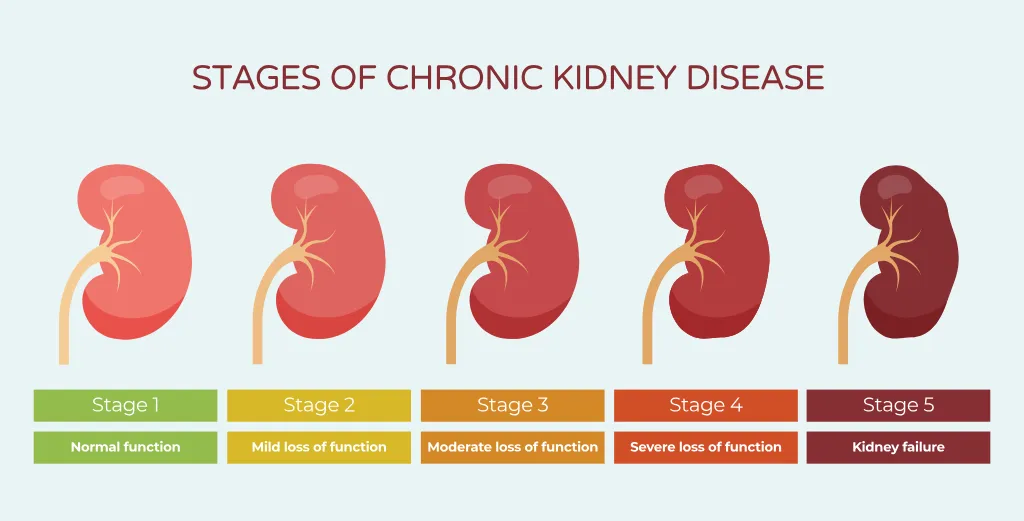
eGFR is only one part of the assessment. Your doctor will also consider the amount of albumin in your urine, the cause of the kidney damage and other health factors.
Your CKD stage helps your doctor determine the monitoring and care you may need.
Why Screening for Chronic Kidney Disease Matters
Detecting CKD early gives you more time to protect your remaining kidney function. Without suitable management, kidney function may continue to decline and can eventually lead to kidney failure requiring dialysis or a kidney transplant. CKD also increases the risk of cardiovascular complications such as heart disease and stroke4.
Not everyone with CKD progresses to kidney failure. Appropriate care can help protect remaining kidney function and reduce the risk of complications.
What Are the Symptoms of Chronic Kidney Disease?
Symptoms are more likely to appear as CKD becomes more advanced and may include3:
- Tiredness
- Swollen ankles, feet or hands
- Changes in how often or how much you urinate
- Foamy urine, or blood in the urine
- Poor appetite
- Itchy or dry skin
- Nausea or vomiting
- Shortness of breath
These symptoms can also be caused by other conditions. Speak to a doctor if you notice persistent changes, particularly blood in the urine or a significant change in urination3.

Chronic Kidney Disease Causes and Risk Factors
Diabetes and high blood pressure are the most common causes of CKD. Both conditions can gradually damage the small blood vessels involved in kidney filtration. Other causes include inherited kidney conditions, inflammation of the kidneys and structural problems that obstruct the flow of urine4.
Who Is at Risk of Chronic Kidney Disease?
Other factors that may increase the risk of CKD include:
- Heart and blood vessel disease
- Being overweight
- Getting older, particularly from age 65
- A family history of kidney disease
- Smoking
- Long-term or frequent use of certain painkillers and anti-inflammatory medicines
- A previous acute kidney injury
- Recurrent kidney stones
Having one or more risk factors does not mean that you have CKD. Your GP can assess your risk and advise whether further checks are appropriate.
How Is Chronic Kidney Disease Diagnosed?
CKD can be assessed using two key tests:
- A blood test that measures creatinine and is used to estimate the glomerular filtration rate, or eGFR. This indicates how well the kidneys are filtering the blood.
- A urine albumin-to-creatinine ratio, or uACR, which checks for albumin leaking into the urine. This may be an early sign of kidney damage.
These tests may be carried out as part of a chronic disease review, health screening or assessment of possible kidney problems. Because temporary illness, dehydration and other factors can affect the results, abnormal findings may need to be repeated.
CKD is diagnosed when reduced kidney function or other evidence of kidney damage persists for at least three months. In some cases, imaging scans such as a kidney ultrasound or further tests, such as a kidney biopsy, may also be needed4.
Chronic Kidney Disease Management
CKD management focuses on protecting remaining kidney function and reducing the risk of complications. The care plan will depend on the cause and stage of CKD, as well as your overall health. It may include managing related conditions, taking prescribed medication and making suitable lifestyle changes.
Managing Related Conditions and Medication
Diabetes, high blood pressure and high cholesterol can contribute to kidney and cardiovascular complications. Keeping these conditions within suitable targets is therefore an important part of CKD care.
Depending on your condition, your doctor may prescribe or adjust medication to control these risk factors and help protect your kidneys and heart. Your doctor will also consider your kidney function when reviewing the suitability and dosage of other medications.
Take your medication as prescribed, even when you feel well, and speak to your doctor before stopping or making any changes4.
Diet and Lifestyle
Everyday habits can support blood pressure control, reduce strain on the kidneys and lower the risk of further damage4.
- Cut down on salt, which helps control blood pressure
- Stay physically active
- Work towards a healthy weight
- Stop smoking
- Be careful with over-the-counter painkillers such as anti-inflammatory medicines, and check with your doctor or pharmacist if you use them often
- Follow your doctor’s advice on fluid intake, particularly if your CKD is more advanced
If your CKD becomes more advanced, you may be given more specific dietary guidance, sometimes with the help of a dietitian.
Chronic Kidney Disease Care at Your GP
Stable CKD in stages 1 to 3a can often be managed in primary care, while people with stage 3b to 5 CKD may be referred to a kidney specialist for shared care. Earlier referral may also be needed if kidney function declines quickly, the cause is unclear or complications develop4.
Your GP can support you by:
- Checking your risk: identifying whether conditions like diabetes or high blood pressure mean you should be tested for CKD
- Diagnosing and staging: arranging blood and urine tests, and explaining what your results mean
- Managing contributing conditions: managing your blood pressure, blood sugar and cholesterol, and prescribing suitable medication where needed
- Monitoring your kidneys: arranging regular tests to track how your kidney function is changing
- Supporting lifestyle changes: providing practical guidance on diet, activity, weight and stopping smoking
- Referring when needed: connecting you with a kidney specialist for advanced or complex cases
Seeing the same GP for your ongoing care means having someone who understands your overall health, can spot changes early and adjust your care as needed. This continuity can be particularly valuable for a condition that requires long-term monitoring.
Using MediSave for CKD Care under the CDMP
Chronic kidney disease is one of the conditions covered under the Chronic Disease Management Programme (CDMP)5. Eligible Singapore Citizens and Permanent Residents can use MediSave for eligible outpatient CKD follow-up at accredited GP clinics, subject to scheme limits and eligibility.
If you are enrolled with a Healthier SG clinic, you can use MediSave to fully pay for eligible CDMP treatment there, up to the prevailing withdrawal limits, without the 15% cash co-payment5. Eligible patients may also receive CHAS, Pioneer Generation or Merdeka Generation subsidies, subject to the applicable scheme.
From 1 January 2027, the MediSave500/700 scheme will be renamed the MediSave Chronic and Preventive Care scheme, and the annual withdrawal limits will increase to $700 for most patients and $1,000 for those with complex chronic care needs6.
All Healthway Medical GP clinics are accredited CDMP providers.
Find a Healthway Medical Clinic Near YouFrequently Asked Questions About Chronic Kidney Disease
Chronic kidney disease often has no symptoms in its early stages, which is why it can go unnoticed. Later signs can include tiredness, swollen ankles, changes in urination, poor appetite and itchy skin. If you have risk factors such as diabetes or high blood pressure, speak to your GP about kidney function testing.
In Singapore, the two most common causes are diabetes and high blood pressure. Over time, both can damage the small blood vessels in the kidneys. Other risk factors include cardiovascular disease, excess weight, older age, a family history of kidney disease, smoking and long-term or frequent use of certain painkillers.
Kidney damage from CKD is often permanent. However, suitable treatment can help protect remaining kidney function and reduce the risk of complications.
Your GP may arrange a blood test to estimate your eGFR and a urine test called a uACR to check for albumin. Abnormal results may need to be repeated to confirm that the changes have persisted for at least three months.
No. Not everyone with CKD progresses to kidney failure. Early detection, suitable treatment and regular monitoring can help slow its progression and reduce the likelihood of requiring dialysis.
Yes. Eligible patients may use MediSave for outpatient CKD care under the CDMP, subject to the prevailing withdrawal limits. CHAS, Pioneer Generation and Merdeka Generation subsidies may also apply.
References
- Ministry of Health Singapore. National Prevalence of Chronic Kidney Disease and Its Impact on Disease Burden on Population. https://www.moh.gov.sg/newsroom/national-prevalence-of-chronic-kidney-disease-and-its-impact-on-disease-burden-on-population/
- HealthHub Singapore. Kidney Health and Kidney Care. https://www.healthhub.sg/health-conditions/kidney-health-kidney-care
- HealthHub Singapore. Chronic Kidney Disease. https://www.healthhub.sg/health-conditions/chronic_kidney_disease_nuh
- Primary Care Pages. Chronic Kidney Disease, Healthier SG Care Protocol. https://www.primarycarepages.sg/healthier-sg/care-protocols/chronic-care-protocols/chronic-kidney-disease
- Ministry of Health Singapore. Outpatient Care and Chronic Disease Management Programme. https://www.moh.gov.sg/managing-expenses/schemes-and-subsidies/medisave/outpatient-care/ https://www.moh.gov.sg/others/resources-and-statistics/chronic-disease-management-programme-cdmp/
- Ministry of Health Singapore. Keeping Healthcare Affordable. 5 March 2026. https://www.moh.gov.sg/newsroom/keeping-healthcare-affordable/