

From 1 April 2026, new requirements for Integrated Shield Plan riders will take effect in Singapore. These changes may affect how much patients pay out of pocket, especially when seeking private healthcare. Understanding the basics can help patients better prepare for what this may mean in practice.
Key Takeaways
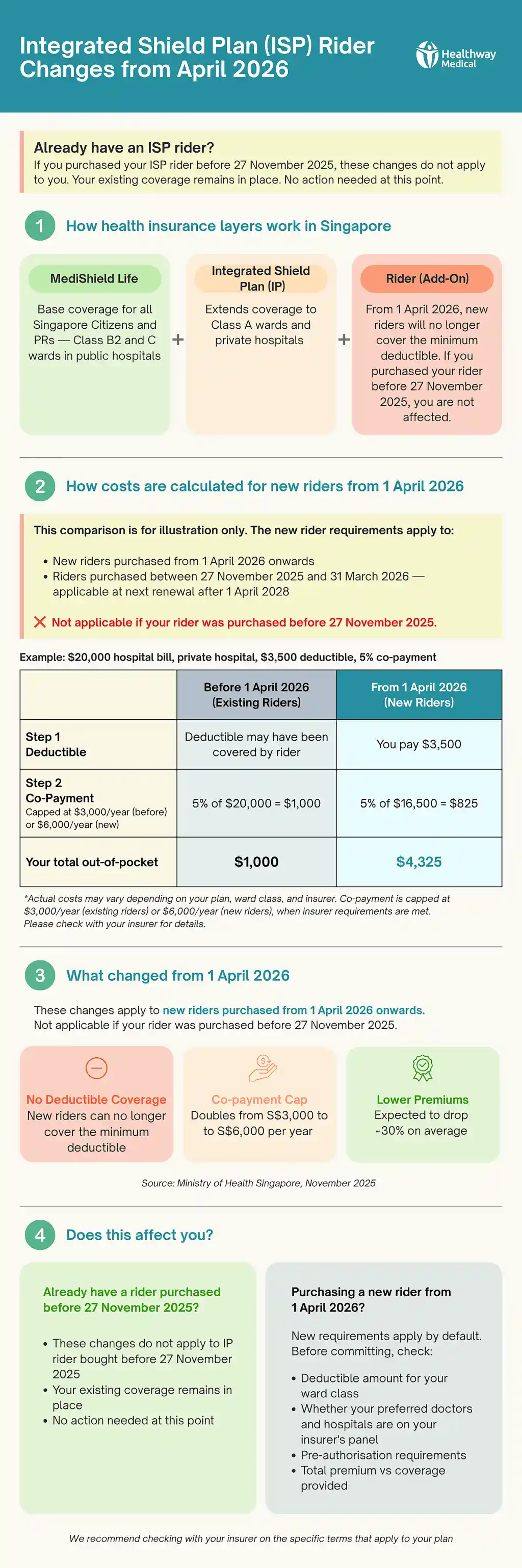
- New Integrated Shield Plan (IP) riders (from 1 April 2026) will no longer cover the deductible; patients will need to pay this amount before insurance payouts apply.
- New IP riders (from 1 April 2026) will carry a higher minimum annual co-payment cap, increasing from S$3,000 to S$6,000, excluding the deductible.
- New private hospital IP riders are expected to cost around 30% less in premiums on average.
- Existing riders who bought their IP Rider prior to 27 Nov 2025, are not immediately affected. Check with your insurer on the specific terms that apply to your plan.
Understanding IPs, Riders, Deductibles and Co Payments

To understand what is changing, it helps to start with the basics. MediShield Life is Singapore's national health insurance scheme. It covers all residents for subsidised treatment, primarily at Class B2 and C wards in public hospitals. However, it was not designed to cover private hospital care or higher ward classes in full.
What Are Integrated Shield Plans and Riders?
Integrated Shield Plans, or IPs, are offered by private insurers and work on top of MediShield Life. They extend coverage to higher ward classes, such as Class A in public hospitals or wards in private hospitals and are available to Singapore Citizens and Permanent Residents.
Riders are optional add-ons purchased alongside an IP. It is meant to help reduce out of pocket costs, such as deductibles and co-payments. Since 2018, IP riders have still required patients to pay at least 5% co-payment, subject to a minimum annual cap. Under the new requirements, this level of coverage is no longer permitted for riders sold from 1 April 2026.
Deductibles and Co-Payments, Explained
Before looking at what is changing, it helps to understand two terms that sit at the centre of these changes: deductibles and co-payments.
A deductible is the fixed amount you pay out-of-pocket before your insurance begins to pay. It resets each policy year.
A co-payment is the percentage of the remaining bill you continue to share with your insurer after the deductible is met. Under IPs, this is a minimum of 5%.
It’s also worth noting that, both the deductible and co-payments can be paid using MediSave, subject to prevailing withdrawal limits. With that in mind, here is what is specifically changing for IP riders.
Changes to Integrated Shield Plan Riders from 1 April 2026
From 1 April 2026, all new IP riders must meet updated requirements set by the Ministry of Health. Two changes are central to understanding how your coverage may work differently.
- Insurers are no longer permitted to sell riders that cover the minimum IP deductible.
This means patients with new riders will need to pay the deductible themselves (between S$1,500 and S$3,500 per policy year) before any insurer payout begins. These minimum deductible amounts are set by the Ministry of Health and vary by ward class. The exact amount depends on the ward class covered under your plan. - The minimum annual co-payment cap increases from S$3,000 to S$6,000.
A co-payment cap is the maximum amount you would pay in co-payments within a policy year. Once you reach this cap, the insurer covers the remaining co-payment portion for the rest of that year. This co-payment cap excludes the deductible, and the minimum 5% co-payment requirement remains in place.
More importantly, the cap applies when patients meet their insurer's requirements, such as using a panel doctor or obtaining pre-authorisation before treatment.
| Before (existing riders) | From 1 April 2026 (new riders) | |
|---|---|---|
| Deductible coverage | Rider could cover the full deductible | Rider cannot cover the deductible |
| Patient pays deductible | S$0 (with full rider coverage) | S$1,500 – S$3,500 (paid by patient) |
| Co-payment | 5% of remaining bill | 5% of remaining bill (unchanged) |
| Annual co-payment cap | S$3,000 | S$6,000 |
The higher co-payment cap means there is a defined limit on what you pay each year. For larger bills in particular, your costs do not accumulate without bound — once you reach the cap, your insurer covers the rest.
Why Are These Changes Introduced?
MOH introduced these changes to address rising costs in private healthcare. A few factors drove the decision:
- When patients bear little to no out-of-pocket cost at the point of care, there is less incentive to weigh whether a treatment or facility is necessary, contributing to over-servicing and higher claims
- IP rider premiums have risen an average of 17% annually over the past three years as a result
- Reintroducing a patient co-share is intended to encourage more cost-conscious decisions while maintaining protection against large bills
- New compliant riders are expected to carry premiums around 30% lower on average, making coverage more sustainable over time
For patients, the most immediate benefit is a reduction in premiums. Over time, the intent is that a more cost-conscious system keeps healthcare sustainable and accessible for everyone.
What Could This Mean for You?

The changes affect patients differently depending on the size of their bill and whether they meet their insurer's requirements. Here is what patients may notice when the changes come into effect.
Lower Premiums
Patients purchasing new riders from 1 April 2026 can expect to pay meaningfully less in annual premiums. According to the Ministry of Health, private hospital IP rider policyholders may see savings of around S$600 per year, while those on public hospital riders may save around S$200. For patients who have been weighing whether to maintain or purchase a rider, this reduction may make the decision more straightforward.
Out of Pocket Costs May Work Differently
Under the new structure, patients with a new rider will need to pay the deductible themselves before any insurance payout applies. In other words, the first S$1,500 to S$3,500 of your hospital bill is yours to pay, regardless of what your rider covers.
When Your Bill Falls Below the Deductible
For procedures where the total bill is close to or below your deductible amount (such as minor day surgeries, endoscopies, or diagnostic procedures) the full cost may fall to the patient. This is because the insurer only pays what remains after the deductible is met. If the bill does not exceed the deductible, there is nothing left for the insurer to cover.
When Your Bill Exceeds the Deductible
For bills that exceed the deductible, the 5% co-payment applies to the remaining amount. Both the deductible and co-payments can be paid using MediSave, subject to prevailing withdrawal limits. Patients may wish to set aside funds or review their MediSave balance to account for these costs.
Coverage may depend more on insurer requirements
The S$6,000 co-payment cap applies when patients meet their insurer's specific requirements. These typically include using a panel doctor and, in some cases, obtaining pre-authorisation before planned hospitalisation or procedures.
Patients who seek treatment outside their insurer's panel, or who proceed without pre-authorisation where it is required, may find that the co-payment cap does not apply. In such cases, the co-payment could exceed S$6,000 depending on the bill size.
This means understanding your insurer's terms and checking whether your preferred doctor or hospital meets their requirements becomes more important under the new structure.
What Patients May Wish to Check
These changes primarily affect Singaporeans and Permanent Residents who hold or are considering an IP with a rider. Whether you are affected now, or at a future renewal, depends on when your existing rider was purchased and what your insurer decides to offer going forward.
Patients getting a new rider from 1 April 2026
If you are purchasing a new rider from 1 April 2026 onwards, it will be subject to the new requirements by default. Before purchasing, it is worth checking:
- The deductible amount for your chosen ward class and whether you have sufficient MediSave or savings to cover it
- Whether your preferred doctors or hospitals are on your insurer's panel
- Your insurer's pre-authorisation requirements for planned procedures
- The total premium for the new rider relative to the coverage it provides
Patients who already have an existing rider
If your rider was purchased before 27 November 2025, the new requirements do not apply to you immediately. Your existing coverage, including any deductible coverage your rider provides, remains in place for now. You do not need to take any action at this point.
There are a few things worth being aware of as time goes on:
- Your coverage terms are unchanged for now. Insurers cannot retroactively apply the new rules to riders purchased before the announcement date.
- A transition may apply if your rider was sold between 27 November 2025 and 31 March 2026. Insurers are required to move these policies to the new compliant design by the renewal after 1 April 2028.
- Premiums on existing comprehensive riders may rise over time. Because older riders carry broader coverage, insurers may increase premiums for these legacy plans. This could make switching to a new, lower-premium rider worth considering at renewal even though it means higher out-of-pocket costs for individual bills.
At your next renewal — any time after 1 April 2026 — it is worth reviewing whether your current rider remains cost-effective, or whether a new rider with lower premiums suits your circumstances better. Your insurer or a licensed financial adviser can help you assess this.
These changes mark a shift in how IP riders work, but the purpose of health insurance remains the same: to protect you against costs you cannot easily bear alone. Reviewing your coverage now, rather than at the point of claim, puts you in a better position to make decisions that suit your health needs and financial circumstances.
Related Articles
Adult Vaccination Costs in Singapore: Subsidies and MediSave Explained
October 06, 2026
CHAS, Healthier SG and MediSave: What’s the Difference?
September 28, 2026